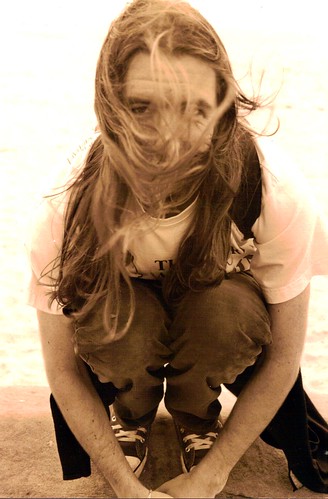
She sits to write, but her fingers freeze.
She sits to write, but nothing comes out.
Snatches of conversations, snippets of thought, countless answers to questions long since past – things she could have said then, but make no sense now.
She sits to write, but the weight of all those words already out there, pushing back against all those clouding her own mind, is too much. They laugh as they casually poke each word that threatens to spill back in, warning her to find a new patch, to go somewhere less crowded.
She’s on her second cup of tea. She’s quite full enough from the first, but the familiar action – the flick of the switch on the kettle, the brief silence, wondering if she has switched it on properly, then the slow hiss as the water begins to catch, begins to swirl, organises itself and votes on which particles will become steam and escape through the spout, which will be poured into the teapot and take on the honey hue of the tea leaves – soothes her.
It’s all part of writing, it’s all part of the delicate mask that must be assembled, the hood put over the writer who must become blank, erased, forgotten, before she can begin. Her stories must not be hers – they can’t be hers anyway, she doesn’t know who she is.
Thinking about who she is is the quickest way to upset her, freeze her. She has no idea. She fancies she should, by now, have a clue, an inkling, an occasional wake-in-the-night connection that whispers to her a truth, a secret, a startlingly clear image that disappears as soon as it arrives.
But no, never. Not once.
Is that why she writes? To find herself? Not likely. She’s looking to lose herself, find out less and less about herself until there’s nothing to know, or not to know, there’s just nothing, which leaves knowing at the door, knocking gently, half-heartedly, disconsolately perhaps, then wandering away, down streets black with lost tears, a black as silky and shiny as a raven’s haunch, a street rustling with the same sound of death upon us that’s brought by that very same raven’s swishing, time-stopping flight.
She sits to write, lost inside that veneer of time that sends the minute hand swirling out of control, yet the hour hand never moving.
She sits to write, but now her mind has wandered. Her nose itches, her foot’s asleep, tucked back under her chair. The birds are carrying on like they’ve just woken to find a new day waiting, but she knows the day is well underway. It’s passed her by really – while she sits, waiting, trying, it’s gone. She has nothing to show for it, no trace of writing, no hint of an idea. She could have walked down to the small park on the corner of her street, felt the sun tickle the back of her neck like a familiar love, pulled out a favourite book, fallen asleep with the smell of its well-thumbed pages and old ink gently wafting into her daydreams.
But she didn’t. She stayed to tackle the empty page, to put her demons to rest, drive a pen through their mocking heart, their leering, jeering faces that once peered round doorways, but now perch happily on the edge of her desk, flipping through old magazines, laughing at her choice of passages pulled from other books, written in her leaning hand in a small exercise book originally bought for her own words to fill.
She sits to write, but blood pounds in her ears, blood she pictures a deep black, a stultifying inky black, blood sour with loss, blood thickening by the moment, stale blood that’s curdling and crusting.
‘Help’ she whispers, but nobody hears.
Showing posts with label flotsam. Show all posts
Showing posts with label flotsam. Show all posts
Thursday, 10 July 2008


Tuesday, 24 June 2008
outing
She stares out of her window, sitting straight-backed behind the empty passenger seat. The passenger door is open, nobody is sitting there. It must be for her mother – the father would be driving, a car like this. The years on her face outweigh her size, the muscles drawing her brow in, like she’s squinting against the glare of existence, or as if she's seen it all before. Seen all there is before her, already. She seems to be wearing make-up, but isn’t. She seems to be looking past wherever her eye appears to be resting. Though it isn’t resting at all, it’s working, always working. What she’s seeing is not necessarily there.
She’s lost in thought. Not imagination, but reflection, not possibilities for the future, but ruminations on the past. She’s all in black, a crushed velvet, lace trimmed. Real lace. Her hair is a shock of white spilling over its gentle, scalloped neckline, preternaturally blonde, prematurely straightened before it could find its natural curl.
She stares at the spot her mother’s heel last trod, before the glossy green door closed. She’s gone back for something – a scarf, a glove, something they forgot to pack as they went to the car. She forgot it knowingly, aching for the moment to herself. She left it on the dressing table well aware she would have to go back, timing it so they were all in the car but the key hadn’t turned. She knew he would be annoyed, knew he would spend the time tapping on the dashboard and looking every ten seconds at its clock, choking with silent rage, as if that would somehow make her any faster.
She walks up the stairs, not fast not slow. Her breath is so tight, her chest so locked, you could hold up a mirror to her mouth and no mist would appear. She wants to go faster because that’s how she does things, slower because she needs that moment to stretch on as long as it can, as far as it can go before snapping.
He drums his fingers on the dashboard. He looks at the clock again, then checks his wristwatch. Its heavy, gold body gleams against his tanned arm, black hairs curling over its band. The cuffs of his starched white shirt peek out past his coat, the gold cuff-link flashing like toothache.
She looks down at her shoes, their tiny buckles, the rough scuff on the end of the left one where she dragged it over the gutter getting into the car. ‘Mother will not be pleased’, she thinks, not sure whether she herself cares. Not sure of anything. She looks at the freckle just below the third knuckle on her middle finger. She scratches at it, as she always does while waiting for something, anything, to happen, but it doesn’t go anywhere. It never goes anywhere. The skin beneath it whitens and the freckle slides back towards her wrist, but then returns to exactly where it had been.
She is too cold, or too hot, but not quite sure which. Her father drums on the centre of the steering wheel, sucking his back teeth.
She is close to the window, so close her forehead almost touches the glass, yet no mist of breath appears.
She closes her eyes.
Thursday, 10 January 2008
dew
hair flares scarlet
mute edges tinged
by sandalwood's
flickering shroud
cross-hatch heavens
peer silently
warm breath nestles
knowing nape
dew drops
lightly night
falls
Tuesday, 28 August 2007
*
You get further as
I draw closer as
You whisper words
That I never thought
I’d hear again
You get closer as
Days grow longer as
You say to me what
I don’t want to know
I get further as
Night draws nearer as
Birds draw wings over
Tired eyes
I get closer as
Those wings draw nearer as
The night draws the curtain on
You
Saturday, 25 August 2007
Regret
I dream of the flower
The bird on the bower
I watch as it takes nervous flight
I spin upside down
Begin now to drown
I wish that I’d wished you good night
Friday, 24 August 2007
Fade
Starved of sun
He fades to an echo
Of what she first thought she had found
His ruby red lustre
Shortly proved bluster
But it was a promise to which she was bound
Steam
The mist of her memory
Pooled on the mirror
Rendering reflection mute
Blocks of non-colour – shapes
Without edges
She wrote her name with a finger drawn
Awkwardly eking
Sudden squeaking
Where she pressed too hard and then slipped
She wrote his name in the space beneath
Had to squash the last letter in
She had not left enough room
Thought he might fit in the space
He did not
Thursday, 23 August 2007
Kindling
Misty matter and pliplop splatter
Winter devotion grows ever fatter
On fire’s warm gloating
And me ever doting
Sending you mad, as they say, as the hatter
Curled up in its shad’der
As smoke climbs the ladder
Of beams that sit under the roof
And if you needed more proof
Of the folly of youth
Then watch us get gladder yet sadder
As the sun starts to scurry
With most undue hurry
Towards hidden homes for the night
Our thoughts turn to dreams
That will burst at the seams
As our angel wings unfurl and take flight
So turning on in
With an end to the din
On the rooftop that sits right above
We lie deep in silence
And consider the violence
Of some little thing they call love
Wednesday, 22 August 2007
Spill
Weeping, soundlessly, wordlessly, a pouring forth of hidden consonants.
Sprouting violently from the ducts, the welling ache of unspoken acts, unacted speeches, unsure of where they might land, what may grow, who will tend the tangled garden.
Not even sure who you are, why you came here, what brought on this sudden – nameless – response, the unbidden retort to the fallen leaf, the slanted light, the crooked branch, the too-soft petal.
Bruised, battered, forgotten.
Alone. Surrounded by the alone. Buried by the alone. Just one amongst many who thought there would be more. Not even special in your pain – it’s everyone’s. Not even different in your torture – it’s the usual.
That’s what is hurting most, that the hurt is not even yours. You wear the cast-off coat of hurt immemorial. And worse: it doesn’t even really fit, the shoulders are too big, the seams don’t align, it sits on your shin (not at all today’s style).
Their words rings in your ears as you lay in damp grass, gazing upon the curve of the sky, the night (endless) and the million pin-pricks that can’t burst it, bleeding its white blood that trickles and winks at you in mock-solidarity. You reach up to tend (or taste) its wounds, but it, like the rest, doesn’t need you.
I really can’t help. Those consonants you cry, the dry, ragged, hoarse scrape of unfulfilled promise, fall in such a twisted jumble that there’s no saving them. Their sharp edges pierce whatever soft rounded vowel tries to tend them, they crash and jangle with no sense of sense. These, at least, at last, are yours only, and I watch as you (cackling) jealously guard over them, sweep them into a little pile of dusty fear.
My tears I offer but they would only confuse you further, although we shall never really know, for you keep them at arm’s length. You are afraid they will melt your edges, your hard-fought angles turned to slippery curves that catch every passing shower, sensuality where there was a steely resolve never to let anything in.
I leave you weeping, soundlessly, wordlessly.
Thursday, 16 August 2007
The Well-Read Man
We sit here on the same bench, every lunch time. I can’t recall who was here first, who joined who. Every day, the pigeons bob their heads and coo, a safe distance at first, just past where our legs would reach if we kicked a foot out (neither of us would), but once we sprinkle a few crusts around they seem to forget our threat. Until next time that is, when we are strangers once again, until the crust offering ritual settles them into their uneasy peace.
They pick up their broken crust in their beaks keenly enough yet seem at a bit of a loss as to how to deal with it. It’s too big to swallow, surely, but without hands, opposable thumbs, a serrated knife and two sizes of fork, what are they to do?
“I know what they’re thinking,” I say. “I can speak with them you know.”
“That’s not true,” she says. “That’s Dr Doolittle.”
“Ahh”, say I, unsure once more. But I had shared something with them hadn’t I? Understood their inner turmoil? Was it direct communication, or merely empathy?
Day after day we come here. I like watching the birds, of course, but it’s the lake that I love. It’s only a pond really, but there’s nothing quite like sitting here, watching the ducks wriggling their fat bottoms in the air as they stick their head under the glassy surface, or making a sudden dash forward as their feet brush a wayward eel, clearly embarrassed at the kerfuffle once they realised there was no need to jump out of their feathers. I like the way the ripples start off around their waist like a duck tuxedo cummerbund, but are soon travelling to the furthest reaches of the pond, concentric circles passing through the water away from the feathery epicentre of their creation, sending leaves bobbing, waving to us, and detaching reflections from their owners.
“You know I was out on a boat once,” I begin, the water pressing me on. “Fishing for marlin. Just me, and the sea. Well, wouldn’t you know it, but I hooked the big one. A terror he was! Dragged me well out. I knew I was in trouble, he was sounding and leaping with a life-force you just simply can’t imagine – once you’ve been on the other end of a line with a fish like this, you know life is far more slippery than we ever imagined. But more miraculous too – and far bigger than you and I, that’s for sure!”
“I see – and then what happened?”
“Well, for days this went on. Day after day I was dragged, into the rising sun, away from the setting, past one horizon after another. Out beyond where the trade currents could even find us.”
“And then?”
“Well, I... I’m not quite sure.” Why couldn’t I remember the rest? How I got home, how I got to be sitting here, on this bench, balling up a crumbling piece of stale white bread by rolling it between my thumb and forefinger and then trying to toss it to a particular pigeon I’ve spotted lurking beyond the usual suspects because he was missing out, but watching him stampeded by one of the more assertive and scared off it just as it was in his reach.
“No, I could never finish Hemingway either.”
“Pardon?”
“Hemingway – you’re thinking of the Old Man and the Sea.”
Week after week we come, day in day out. We rarely talk. It’s like we don’t really need to, like there’s a shared history linking us. But it can’t be so – I don’t even know her name. Even through summer not a day is missed, no matter how warm it gets. It’s a relief when the shadows finally start to lengthen, when the pigeons seem less frazzled and lethargic in their feathery coats, almost annoyed at having to move to collect their crusts.
“You know there’s something about this time of year that is remarkable. It’s just the most subtle of shifts, but the light in August truly grips me.”
“Is that so?”
“Indeed it is. A man can sit here, the weight of the world just kind of dropping off his sloped shoulders, shrugging maybe, at one moment those rounded corners of his uppermost corporeal existence lifted around his sinewy neck as though pistons have pneumatically though silently cranked them to their most austere reach, then dropped again, all while barely seeming to move to anyone who might be watching, but to him shifting more than his shirt, shifting the weight of his mind, his thoughts, all the preceding things that bumped up against him all that long day, or flying in from a day he may have momentarily thought back to – a memory cobbled of a fleeting instant that made no real impact at the time, but was coming back to him at this very juncture for who knows what reason, bearing what message – all this sitting there on those shoulders, each shoulder with its own story to tell, its own memories fashioning into a different knot; knots of hope, of dreams, of unanswerable puzzles, all their own distinct shape and all jostling for space with the devil and the angel, the dandruff and the pollen, ephemeral tokens taken for granted as always there yet never the same, while all the while he sits, looking (possibly for the first time in days) at something like these ducks – really looking, not just registering them in the primal part of his mind that processes all he needs to keep out of danger, no more no less, but really seeing them in their splendid sentience – and willing these knots to be gone, for the ducks or whatever he is focusing on, be it the cracked and crooked light, or the tepidly waning warmth on his cheekbones and brow, to take their place, to become the new knots; for he knows there will always be knots, but if we can at least choose what the knots are going to be, what form they take and how they will line up, then we can let that weight that doesn’t really belong to us anyway disappear for just that fleeting moment, allow that glimpse to be a conduit, a window into the soul of the world – a two-way window that puts the world into his soul.”
A long silence followed. I wondered if perhaps she hadn’t heard, and even had a slight panic that she had left – I began to wonder if perhaps I hadn’t even said anything; that my mind had drifted off on an internal tangent of tangled and confused words that I still see bouncing and buffeting around haphazardly on a layer of cool green felt. But then:
“You like Faulkner too then?”
“Faulkner?”
“Never mind.”
Sometimes there will be others. A mother showing the ducks to her child, encouraging her young progeny to replicate the noise a duck might make; an old grey man in a too large coat, young lovebirds early in their courtship with brows blissfully unfurrowed.
There seemed to be an almost unseemly amount of the latter this autumn, crowding the pond’s edge and sharing cheese and bread on stolen lunch trysts or walking arm in arm as the sun dipped behind the church that stretched skyward over on the far side of the pond, its dying golden rays no doubt mistaken by many as lending an unearthly religiosity to the rough-hewn stones and faith-charged steeple.
“Oh to be that young and carefree again,” I sighed.
“Mmmm,” she returned, the loose skin across the knuckles entwined in her lap rippling a little as she stretched them.
“Did I ever tell you about my first true love? We were very young, the two of us. Our families were embroiled in a most terrible feud, but by a stroke of fate we were brought together. How I fell for her! Her family would not have it, of course, she was desitined for higher stations, greater things, but though I was banished from her side, we met again the very next day and were furtively married. Well, things took a dramatic turn for the worse I tell you... much scandal and mayhem was to follow - great tragedy in fact - but I think that I may have already said too much. Tomorrow – tomorrow I shall tell you more.”
She smiled.
Soon the clouds returned; blindingly white and bilious. I knew what this meant and, sure enough, small flecks of desiccated snow soon danced across the streams of air, jigging to and fro as haphazardly as a sea of butterflies migrating to only they know where. Each was a facsimile of the other, each wildly unique. At first they would fall and we would watch them disappear, leaving only a darkness, a tiny moist spot as black as the flake was white. But, at one point – you could never say quite when – they stayed as they were, welcoming the next flake and the next, linking outstretched hands until they were not flakes at all, but an undifferentiated blanket; soft, hard, delicate, crunchy, welcoming, treacherous. Of the sky, the air, yet of water too. Land, also, a new earth to replace the old, a layer or crust upon which a new layer of life would wander, seeking out its own stories. And fire – cold enough to burn.
“This snow,” I say.
“Mm-hm?” she allows.
“It is qanik – big, almost weightless crystals falling in stacks and covering the ground with a layer of pulverised white frost.”
“Is that so?”
“Oh yes. That’s what we get here, of course, with these snow flurries. There’s not much likelihood of sikussaqi, or hiku – certainly no chance of hikuaq or ivuniq. But we’re still a chance of some apuhiniq if that wind keeps up and compresses it.”
“Hmmmm.”
“If you’re wondering how I know all this, my father was a scientist and my mother a Greenlander.”
“How wonderful! That means I have the pleasure, then, of sitting with Miss Smilla?”
“Excuse me?”
“You must be Smilla Jaspersen – fearless avenger of the death of six-year-olds, with a rather advanced feeling for snow.”
“Well, no, that’s not my name.”
“No, I imagine not, but it is the name of the person you’re thinking of – Peter Høeg’s best-known character in his worst-endinged book.”
“Is endinged even a word?”
“How would you say it?”
“Worst ended. Worst finished. Book with his worst ending. I don’t know, that’s not really the point – you’re saying that it’s not me?”
“Who knows? It might very well be. You’ve not ever told me your name, where you live, what you do when you’re not sitting here, so perhaps you are all the above and more. Tell me – do you rent a small room and a write a manifesto that a young boy will one day read and discover you to be the Steppenwolf? Did you wake up one morning to find you were on trial for a most serious crime but could not find out what it was supposed to be? Is everything you do and every conversation you have under surveillance by an omnipotent controller? Have you ever lived in squalor and tried justifying to yourself the murder of an old person? Were you ever washed up on a deserted island after a shipwreck? Did you, perhaps, spend year after year riding the countryside on a donkey, tilting at windmills, in the hope of winning the heart of a beautiful damsel? Or maybe you were born near midnight on the day your country was also born and you have magical powers that enable to you to telepathise with all the other children born that day?”
I was confused. All this felt so familiar. But how did she know so much about me, my past?
“Well, yes, I think so.”
For the first time in all the time we had been coming here, she turned to look at me – really look at me.
“I thought so too. Then surely you remember me? It’s me, Juliet.”
***
I smile sadly, slowly shaking my head.
“That’s not how it ends,” I say.
She fixes me with a steady gaze, blue eyes dancing with the last of the day’s reflected light.
“But why on earth not?”
“That’s too neat. Too tidy. Too soon. Worse – it’s cliché.”
“But this isn’t a book, a fiction, a made-up story. This is life.”
“In life as in books. Many things are forgivable – the most heinous of crimes against humanity, or love, or indeed both, can be carefully constructed, retold, refashioned, so as to explain them away. But cliché – unforgivable. A fate worse than death.”
I stand, brushing the crumbs that had collected on my jumper onto the ground, folding the paper bag now empty of bread into quarters and carefully placing it into my pocket. I walk away.
Monday, 6 August 2007
Maps (silent)
These silent maps, a Mute cartography,
Tracing forgotten journeys of dreams and solitude.
Etching contours of valleys and hills that none have in flesh traduced
He relies on the taste of the air hidden beneath the tail end of the trade winds, the known routes through territories delineated by impossible events, veiled rumours, unspoken struggles.
To read his maps one must have fingertips as light as forgotten snow
Dancing up and over and through, the drop just one of the thoughts of freedom that sidles alongside the rest
There is no sound to share the stories yet untold, unlived – to break this vow a risk; a shattering of lips
Cracked and parched with the raw essence of life lived in salt, brine blood
Within each, its own, unheard
What music, then, what notes do we allow?
The moon for one, the milk of eternal renewal, that waning breast that feeds us until we, with it,
spill
From over the side a splash a splash; the ripples of a time that stays a beat ahead of our best guess
It takes more
It takes
The silent awareness of patience and time
The place where they meet and sketch out lessons to take to heart and slip into crevices
Safely stowed for the time that follows time
A pencil scrape
Nothing more, no less, a graph of the space within
Where our own leaps and splashes go unseen by most until after we’re gone
Beneath the surface we spend the rest
We can see the air they breath but it’s not for us. When we do, finally, dare to taste
we find it for what it is – a promise broken before uttered
Theirs, though they do not see it. It had been ours, too, but we let it go
To taste the other side. And what do we know about where we are? Less and less until the smallest snippet
Becomes so important we lock it away so nothing more can be taken from it
There, starved, of light, touch, belief, it grows in the eyes of others as it dwindles away to nothingness.
The less it is the more they believe until gone, they demand its release, to see it
Too late? They won’t accept they can’t accept they won’t accept that
They invested their dreams hopes lies into its story, carved etched and burrowed every vein they could and let it bleed in, bleed out.
They thought they knew. The less they remembered the more they grew sure they had the essence in their eye
But blinded to the hollow heart they see a glow brighter than a million suns
And what of the map? Its mute glory
A work of peerless breadth.
They turned it over and began again – none trusted its silent truth
A new truth was drawn, loud and clear – a single kernel spun round and round until it resembled this one small thing – the everything it promised.
How to explain its contradictions and crossed paths, contours in twists and tangles – words.
Words that glossed its impenetrable heart, that slid in and filled, every groove that grew
Matter not that the words had no trace no truth no understanding
Matter not that the words fought amongst themselves for attention, to blindly lead
Matter not that the words no longer bore resemblance to the immutable heart, for they no longer cared
The words chose to ignore the map, to leap off and enter the very world they believed their own
They danced a merry dance they did, believing themselves king
What fear was there of overthrow when they had drawn the rules
What fear was there of falling off when they had drawn the edge
But of course, boys and girls, you know it’s not that simple
The rules they drew the edges they knew
Were nothing like the world that existed beyond the page that had been the world in which they grew
They tumbled and fell, twisted and yelled, slipping into the abyss
The end was swift and merciful – and in their wake; silence
The silent map, the mute cartography, outlived them one and all
It had no need to assert itself against that which it knew so well
Content to live and breathe the air that coursed across the plains, that dipped from mountains high above that fell with fresh new rains
The stars they knew they smiled to see
The taste, now, of earth and clay, stale before its time. The smear of mud and blood and gore of metal twisting
The barren shore, the desert wreck, scoured of the fleeting life, that tricked itself into believing
It knew the answer
It did not
Saturday, 28 July 2007
Sea

By night, she is herself. Free to be what she was born to be. Their mutual yearning for each other hidden by day, her infinite depths now whisper to her lunar love. But, even by night, it is never truly consummated - despite their slow and silvery dance. Their distance draws them together yet keeps them apart.
You turn to her seeking... what?
Wind drops, birds nestle in, the sun's distracting glare has long since moved on to wake distant cousins. It's her turn.
You smell her. The salt of the ages, yet a fresh and freshening sense of surprise, of birth. A hint of her secret garden, pleasantly pungent seaweed set adrift, escaped from its bed and wandering a dance with its partners of tide and fate.
You hear her. Listen long enough and her language grows clearer. Untranslatable, yet she needs no translation. From white noise emerges her voice, a surging whoosh a crack a thwump as she rears breaks tumbles, spilling in a shock of sudden release. Then; a sucking slurp as she returns, coaxing with her the fine sand, the crushed shell, the rejected rock.
You see her. She is black, smooth, ebony silk, a thick, used oil; tar. You could walk on her as though down a road, following the moonlit trail to her outer horizon, then up up up the beam to the moon herself. Yet this is myth - she's no longer black, she's now white. She's writhing, prostrating herself at your feet.
You touch her. She's warm. She's cold. She's wet. She's gone. You step nearer, she slides away. You step nearer, she rushes back. A collision course. But she hasn't seen you, she runs on up the beach. She leaves you again, as though you had never met. You plunge in. Under. Through. You are of her. You cherish her weightless embrace, her power over you - she sweeps you off your feet. Away from her edges you are lifted, but know she shan't let you go.
You taste her. She is on your lips, a tang a tingle of salt's hunger. It's water but it burns, slowly, imperceptibly.
It is night, her night.
Friday, 23 March 2007
Adrift
You never fail
to point out those
who fail to be themselves
as you yourself
fade
before my very eyes
Glazed as they are
with too many hopes
adrift
cut lose to sink
or
swim
You leave it to me
to find out what is left
when all scrubbed
to render it clearer
is rinsed away
The answer is
nothing
You wonder how long you
must walk the wrong path
to find the right one
How long night goes on
before daylight breaks
The answer is
forever
nothing can be forever
I wonder where your emphasis falls
how you sound this out
what it says about you
what you blame me for
nothing is forever
does it say more about me
or
you
No thing can forever be
what it is
or isn't
Yet still we can say
we have dreams
we have songs
we have life
These made up things
so deathly real
Thursday, 22 March 2007
Schatten II
I've seen it. What happens when your shadow leaves you.
It may not stray that far but the disconnect is profound. Shattered into a million tiny pieces, each gleaming with a darkness such as you've never before seen, inky droplets of spilt soul.
Before returning to its caster, it returns to itself. Shards and drops and glops and blips and whisps of it, coalescing, regaining its original stolen shape. Watching it regroup is like watching a child take her first step, say his first word - there's nothing more natural than a shadow wanting to be whole, but it still hits you like nothing before has.
Once regrouped, it slides back to its creator, rejoining her in a consuming crescendo that you will never forget, a howl from the bowels of hell.
This may surprise you. You might have expected it to creep quietly, to sneak back sheepishly - not a chance. Its return coincides with an earth-trembling blitzkrieg of white noise, a terrifyingly blinding encounter as piercingly bright as shadow itself is ceaselessly dark. The shadow must confront and overcome its other to have any chance of taking back its rightful place.
Why did it leave her? That's really the story - but that's for another day.
No, that's not good enough, that's too easy.
But let's start with this - what did she do while it was gone? What recipes for a new life did she concoct from this brief taste of freedom?
None. She died her little death, paralysed by the sheer fear of it all, the unbearable, unbreakable grip loneliness took when it tore her from the safety blanket of her own shadow.
Confining her in its own idea of who she was, it gave her a reason. For being, for anything. Without it, what did she really have? Nothing to call her own. Things, yes. Relationships, perhaps. But what of her was there? What reminder of her place in this world, a placemarker on which to pin her little hopes?
When her shadow left, banished to teeter on the precarious edge of existence, it took far more than she bargained.
It took with it her soul. That's where it is kept - not inside, where we think, but there in our wake, an inverted void that catches and stores our dreams our mistakes our hopes our wrong turns.
So now we know - it went because she demanded it. She wanted to know what it was like to shed this past, these tokens of memory and the detritus of moments lost and washed up again.
She willed its retreat with unimaginable strength, a strength only surpassed by that with which she wished its return.
Wednesday, 21 March 2007
Snuffed
False starts. Starts are easy, but then...
We can all start, a thousand first lines and thoughts. What we hunger for is the next step. Yet what tends to follow is a stumble, a stutter, a sputter.
Excitement follows the first flicker of light, the rasping as the head of the matchstick drags along the side of the box, the miracle of miracles as friction becomes flame.
We watch it dance its sad slow dance, perched atop the brittle wooden stake, born to burn. Minutely it sinks, wrapping around itself and licking at its future.
Too often we give up at this point - transfer the flame to the safety of wax, or, every now and then, flick it into a pile of paper, twisted and scrunched and offering. We love to see it dance, though we don't want to stand too close. We don't want it to lead.
Only rarely are we prepared to hold it, to will it to continue its path, its slow wind towards us. What will we do when we meet? How will it feel?
We feel it before it arrives. It hints at what it will bring. Hold on, and what follows will stay with you. Reinvention is possible. The phoenix, we know, does not simply arise. It must first embrace the flame that promises its own demise, must enter it fully and surrender completely. So must we abandon all hope to discover it.
The heat is intense, the flame bearing down, only a moment longer and the door will open, the next step appearing.
Air expels through twisting lips. Darkness falls.
Friday, 16 March 2007
Ink
I hover above you. You are so white, so clean, so pure.
But I know this isn't true. Beneath your surface you're seething, bumbling with history and a jumble of unuttered thoughts, unthought ideas, idealistic hopes - just waiting for the skin to be pricked, the bubble to be burst so you can ooze forth.
I hesitate. What will happen once I make my first scratch? What will be revealed, what festering mess of hurt and repression or joy and inanity will race from the smallest nick, unstoppable once it starts?
Will you reveal things even I don't yet know? Is that part of your trick, your show?
Ink is your lifeblood, it gives you your weapon - the pen mightier than the sword, particularly against those who wield it. You sip on it greedily, soaking it into your fibres and refusing to let it go once it spills. We can try, smearing it across you or scratching over and over until the pen passes through you, but by then it's too late - it's escaped us.
You are a mirror, your reflective surface bouncing all light, but all dark too. The light is easy enough to find, it jumps out in dazzling white for all to see. It's the dark that the scratching reveals, the shadows within. The ink we spill over you is the toxic blood that courses through our hidden veins - black, murky, staining. It's best we release it through you, rather than spilling it on loved ones, rather than keeping it in where it can do no good.
I hover above you. You are marked, sullied, impure.
Sunday, 11 March 2007
Chloe

Chloe is a city that has never seen sunlight. A quirk of fate finds her located in a valley so steep that even summer's apex affords only a teasing hint of Sol's outer radiation.
The people of Chloe know this and know it better than they know themselves - that the sun will leave them little more than scattered ash and smoking shoes if it somehow crosses their path, or they its. Generation after generation has shared stories of foolhardy souls who ventured over the rise of the hill, never to return again - victims of their own misguided bravado.
The more adventurous children, emboldened by mutual egging, will venture up the face of the steep northern hill in winter, chatting gaily at first and twittering with nervous anticipation, but growing more sombre as they near the top. The silence that soon envelopes them, vibrating with the fear that a mistaken step could see them perish, reinforces the perilous nature of their venture.
A narrow outcrop of rock near the top marks the outermost limit of their courage, a demarcation of their destiny. The breeze carrying with it perfumed warning of sunshine's imminence warns them not to go any further. They heed this warning above all others.
They leave their offerings - carved figures, small stones and bright beads, short pieces of coloured string. These they add to the growing pile of tokens, humble gestures to the absent yet ever-present sun.
Chloe may not have seen the sun, but don't think it's no less in her thoughts than for the rest of us. Quite the converse is in fact true. Everything about her can be related, in ways small and not so small, to their troubled relationship. Her people - pale, drawn figures, sallow of skin though remarkably cool of temperament - spend long hours in thought and conversation about the day of its eventual return.
They know it will happen. Many, indeed, secretly hope it will be in their time, but nobody will say as much. They know it will mean the end of them all, of life as they know it, but it has long had such a command over their life that the desire to finally meet this maker is so magnetic their dreams are richly soaked in bright golden licks of flame and combustion.
There is, of course, a time when the people of Chloe are reunited with the sun. In death they are sent to her and become part of her. Wrapped in crisp, unused, pure white sheets, they wait. A pyre is built. Amidst incantations from family members, the body is placed into the heart of the dancing flames. The soul of the deceased, until then trapped in the body, joins the smoke spiralling skyward. They watch as it passes high above the city, reaching the top of the hill and mingling with the sun's light, entwining and joining her.
This is why she will return one day - to see the city from which she has come, to return home. For she is entirely of Chloe - she is Chloe's past, she shapes her present and she is her only imaginable future.
Thursday, 8 March 2007
You keep me in your pocket. For good luck I expect. Whenever trouble is in the air, looms around a corner with you in its sights, your hand closes tightly around me, your sweat and heat transferred as you take heart in my cool dry smoothness, my flinty resolve.
I take these clammy wrappings well, without a fuss.
You found me by the sea, pocketing me as though I'd been waiting for you to come along the whole time, but to be honest my mind was on other things.
My smoothness is born of the sea, she would caress me and smooth my rough edges, calm me with her deft touch. Now I sit in your pocket and am similarly rolled, similarly clenched. It's not as pleasant, I must admit, but it's nice to be loved.
Once a week I sit in a small box, thin card and smelling of new shoes, resting on crumpled white tissue paper, while your mother washes your trousers, my home.
I miss you.
***
I keep you in my pocket - for good luck. I found you on our last family visit to Brighton, when Dad was still here. I picked you up to skim you across the glass sea, so smooth I imagined it a mirror the sky had breathed upon and polished with a cuff.
My arm was back and I was ready to send you across its face, hoping for at least six bounces before you would have dipped beneath its surface, lost forever. But something stopped me - a strange sense that I would be casting off a piece of myself if I let you go. Mum called and I turned. She was waving for me to come up and join her, so we could leave. I slipped you in my pocket and I have kept you there ever since.
I get so hot sometimes. When the teacher calls on me my ears are aflame, when those boys from the estate block my path home the fire shoots up my throat to my face, bringing with it volcanic bile from my constricting stomach.
You're the only thing that can bring that heat down. Preternaturally cool - I learnt that word last week. It means you're cooler than you should be, that there's something strange in your powers.
I've never shown you to anybody, I think that's part of how you work. You have to stay mine and only mine, nobody else can know that you're here or it won't happen anymore. You won't be so cool and I will get hotter and hotter until I burn to a crisp, my ashes scattered across this godforsaken town.
Thursday, 1 March 2007
Schatten

You think I’m gone at night. I’m happy for you to think that, but it’s not true. You think all you need to do is turn out the light and I cease to be. That doesn’t make me go, it just means you can’t see me.
You think you’re more real than I, but consider this – I’m still going to be here when you expire.
You sit there on your bench, eating your sandwich – tomato, lettuce and tuna on rye bread, I remember when we made it back in the kitchen, your sad and lonely kitchen - looking down at me. I can see you’re looking at me, but you won’t know which way I’m facing. How could you?
I know what you’re thinking. I’ve been with you your whole life, how could I not? You’re wondering whether I would ever leave you, betray you for another. For this I commend you, for at least it shows you know who is in charge.
It’s not that you’re afraid of losing me so much as what I could tell. Believe me, your secrets are no different to most others. Are they even secrets if everyone does these things? I suppose they are if you treat them as such, if you let them fret you so.
There is the companionship element too. You wake up each morning knowing that I’m going to be there when you rise. My presence reassures you, I can tell. You hate the middle of the day, when I shrink down to almost nothing, taking my respite from the heat.
Your favourite time is the fleeting window at the end of the day, when I reach out from you and touch all manner of things, everything I can get my hands on. I lean up against other people, embrace them in ways you wish you could too. I climb walls, I soar across roads and fields to welcome the moon, while you stand watching, envious of my freedom, my fearlessness. You love walking under street lights, watching me race on ahead, leaning out and showing you the way.
Sometimes, when we’re alone, you’re too ashamed to have me where you can see me. You turn the lamp beside your bed so it sends the light across you rather than from behind. I know it’s not as good for reading, but it means you don’t see me lie across the bed and rest up against the wall opposite.
You think I won’t judge you that way, which is patently ridiculous. I’ll always judge you, see how poorly you measure up to what you could be, gently mock your weaknesses. It’s not spite, it’s just my job.
I lied about being there during the night. Sometimes I stay, sometimes I go. But regardless of what I do during those quiet hours when you lie in troubled slumber, the places I go and the things I see, I always make sure I’m there when you wake up, right there beneath you.
Despite my disdain for your manifold foibles, my frustration at your ceaseless self-abasement, I do have a certain soft-spot as well. We've set off on this journey together and I made a promise to always be here. It's part of the deal; that next time round it will be my turn - I will be fleshed out, given the taste touch tactility you waste on your descent into decay, while you will return to be there for me, as my shadow.
Wednesday, 28 February 2007
My summer holiday

My summer holidays were great. I went to the zoo and saw elephants, giraffes and tigers. There were monkeys with big pink bums which was gross. I took my sister, but she must have escaped as she is still peskering me.
When I went to summer camp it was great too. There was a pontoon on the lake and we did bombs and had wrestlings. One time I was the last one to stay on and I won a chocolate bar. I stayed on the top bunk which was good because Toby was on the bottom and he wet the bed twice. He’s such a baby.
One night we had a fire and I ate a whole bag of marshmallows, pink and white. I didn’t feel too good and my teeth buzzed. My spew was real pink.
When I got sunburn it was cool. It stung for ages but then when I was peeling I grossed everyone out so it was worth it.
My grampa came to stay at our house and he smelt funny. He slept in the daytime and snored.
Mum said he wasn’t well but dad said he was a silly old bastard.
I didn’t see much of Matthew because his mum moved and took him too. He said his dad wasn’t going with them because his mum was getting a new dad.
Once, when it rained and I couldn’t go outside, I went around the house and lit all the candles.
I hardly got any wax on the carpet or the tables at all, but you wouldn’t know it by the way mum looked when she smacked me and sent me to my room. Dad said it was her fault for leaving the matches where I could find them and he was heaps right. If they didn’t want me to do it they shouldn’t have left them in the draw. They had said I was never to go near them, but that was when I was as little as my sister. We lit heaps of stuff on camp, leaves and stuff.
One night I couldn’t sleep so I went to the kitchen for a drink.
I could hear mum and dad talking through the door. They were talking about what they were going to do with him and I thought they meant grampa.
But then they said stuff about stuff that I done, not bad stuff just stuff when I get bored, like the candles and that thing I did with the toothpaste that time.
They said stuff about a boarding school which would be cool cause then I could stay up til I wanted and not have them grumping all the time.
But they mustn’t have decided I could go cause now I’m back here in this dumb class and have to write this stupid assignment on my summer holidays.
Subscribe to:
Posts (Atom)